
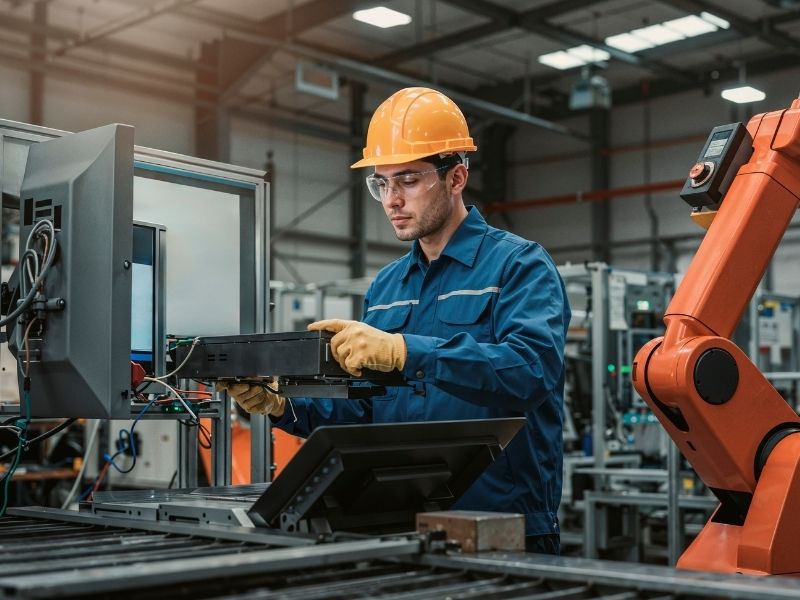
CNC machining continues to be a cornerstone of contemporary production, enabling precise creation from initial models to mass-produced components. However, starting in 2025, machine shops are moving beyond merely shaping metals with computer-guided machinery; they are revolutionizing manufacturing practices by adopting automation, intelligent systems, eco-friendly solutions, and innovations driven by digital technology.
These transformations are altering the functionality, effectiveness, and competitive edge of CNC machining within international markets.
Artificial Intelligence and Machine Learning Integration
One of the major factors that revolutionized CNC machining is the use of artificial intelligence (AI) and machine learning with the purpose of improving the quality of decisions and the efficiency of the output. Modern CNC machines have already the most powerful AI algorithms that are able to monitor the equipment’s sensors and devices in real time in order to optimize the movement of the cutting tool, predict when it is going to need maintenance, and change the cutting parameters automatically. This kind of automation is very smart and can lead to shorter cycle times, lower rejects, and higher OEE (overall equipment effectiveness). Moreover, AI plays a role in the maintenance scheduling through the prediction of the failure of machines. Unlike static maintenance routines, AI tools can predict the parts of the machine that are going to fail based on the analysis of temperature, vibration, and tooling factors. The early detection of these problems enables the manufacturers to prevent costly downtimes and also extend the life of tools and machines. In this changing environment, the sectors served by Aerotech Machining are gaining benefit from such innovations, with machine shops catering to the industries that demand speed and precision, like aerospace, automotive, and medical manufacturing. Besides, these systems not only help with quality control but also by spotting the anomalies before the parts are passed on for further processing. Machine learning systems get more accurate as the data size gets bigger which means there is always room for improvement without having to adjust the machines manually. AI-based simulations also reduce the number of test runs by virtually validating the setups before the actual machining process starts.
Smart Factories and IoT Connectivity
Connected IoT sensors and devices have enhanced the intelligence and transparency of CNC machinery. Integrating IoT technology enables remote monitoring, immediate diagnostics, and wireless interactions among devices on the manufacturing floor.
With sensors transmitting data to central management screens, operators can monitor productivity, detect irregularities, and arrange maintenance proactively.
This interconnectedness supports Industry 4.0 frameworks, where machines, tools, and systems communicate effortlessly. The outcome is a smart manufacturing setting that minimizes waste, maximizes operational time, and fosters rapid, data-informed decision-making.
Lights-Out and Fully Automated Machining
While automation has been part of CNC machining for many years, the current advancement is lights-out machining, allowing machines to function with minimal to no human oversight.
The combination of automation, robotics, and intelligent material management enables production processes to continue unattended overnight or on weekends without manual labor presence. This shift is motivated not only by labor cost reductions but also by increased consistency and production output. Robotic arms are capable of loading and unloading components, conducting in-process inspections, and managing fixtures that were once performed manually. This capability is particularly vital for manufacturers struggling with workforce shortages.
Hybrid Manufacturing
CNC machining is gradually merging with other manufacturing processes to form hybrid systems. Hybrid manufacturing integrates subtractive machining with additive manufacturing (3D printing) in one smooth operation. For example, a part can be built up in layers from the plastic to the metal, and then be finished up to a very fine tolerance using CNC machining. The hybrid process has many advantages such as reduced material waste, faster production of complex shapes, and increased design flexibility. These systems are particularly useful in industries such as aviation, medicine, and luxury engineering parts, where complexity and accuracy are very important. Multi-Axis and Ultra-Precision Machining Multi-axis machining centers have surpassed 3-axis CNC machines in terms of versatility and precision.
Machines equipped with five or more axes can access a component from several angles during one setup, which decreases the necessity for fixture alterations and boosts precision on complicated profiles. In conjunction with multi-axis equipment, ultra-precision machining methods are on the rise. These techniques involve extremely detailed control over tool movements, allowing for surface finishes that meet micro- or even nano-scale tolerances.
Such functionalities pave the way for sophisticated optics, high-performance bearings, and accurately crafted medical components.
Cloud‑Based Systems and Digital Thread Integration
CNC operations are being completely transformed by cloud technology. The adoption of cloud computing has brought about the development of platforms that provide storage for programs that are very secure, collaboration in real-time across various locations, and getting access to the most advanced analytics without the need for a significant local infrastructure. CAD/CAM files can be shared between engineers and operators in seconds, thus speeding up the process from design to manufacturing. The online link strengthens the integration of design, manufacturing, and quality data across the whole life cycle of a part, thus breaking down the barriers and providing total traceability. Manufacturers with this much transparency can handle changeovers in a more efficient way, assure the quality of their product through constant monitoring, and they are also able to react to demand changes much more quickly.
Advanced Materials & Tooling Technologies

The CNC industry is not only focusing on the traditional metals like aluminum and steel but is also already utilizing advanced materials including composites, superalloys, and high-performance plastics.
The properties of these materials complicate machining; for instance, they cause tool wear, create thermal stress, and have an impact on surface quality, thus demanding new developments in tooling materials and coatings.High-tech carbide, ceramic, and polycrystalline diamond (PCD) tools increase the production’s durability and efficiency while the smart tool monitoring systems help in finding out the wear before it affects the quality. The developments in machining capabilities are such that the manufacture of parts which were earlier considered to be very hard or costly is now possible.
Sustainability and Green Machining
The environmental responsibility issue is taking the lead in CNC machining. The industry is turning to methods involving less power consumption, recycling of the coolants, and cutting back on the waste. Among these methods are the use of energy-saving servo systems, near-dry machining, and cooler recovery which are all cutting down the carbon footprint while maintaining the output quality. The big shift is not only in the manufacturers’ production processes but also in the goals of hygiene and the requirements directed by the government. There is a continuous transformation in the mind of the clients who are on the lookout for suppliers that can give them proof of the eco-conscious practices in manufacturing, thus making sustainability a competitive advantage.
Improved CNC Programming & Next‑Gen Interfaces
CNC programming has moved past the G-code that was once the mainstay of the industry. Slicing, particularly the CAM software that utilizes AI in toolpath development, has made the programming process much easier for the user. Moreover, the automatic code generator tools not only create optimized codes but also help reduce the chances of making errors and set up time. In addition, the new standard STEP-NC that embeds even the most complex design data into the machining commands directly, is a step forward towards the file format that is not only semantic but also versatile thus completely replacing the G-code. It might still take a while to popularize but the advancements already point to a future trend of manufacturing that is intelligent and thus based on models.
Quality Control & In‑Process Inspection
Quality assurance in modern CNC systems has been directly integrated into the machining processes. During the part production, high-precision probes, laser measurement, and machine vision check the specifications and thus the parts are allowed to be corrected immediately or non-compliant features dismissed. Consequently, the need for separate inspection processes is reduced, quality good in the first pass is raised and production throughput is increased. In such industries as aerospace and medical where stringent regulations are imposed, in-process inspection is mandatory to maintain a high level of quality. CNC machining is going through a major change in technology. AI, IoT, hybrid manufacturing, and eco-friendly practices are among the drivers that are increasing the limits of precision manufacturing. As manufacturing needs change and industries seek faster, more efficient, and eco-friendly options, CNC machining will continue to evolve and innovate thus creating new opportunities for companies that adopt these technologies.












Leave a Reply